Our Location
304 North Cardinal St.
Dorchester Center, MA 02124

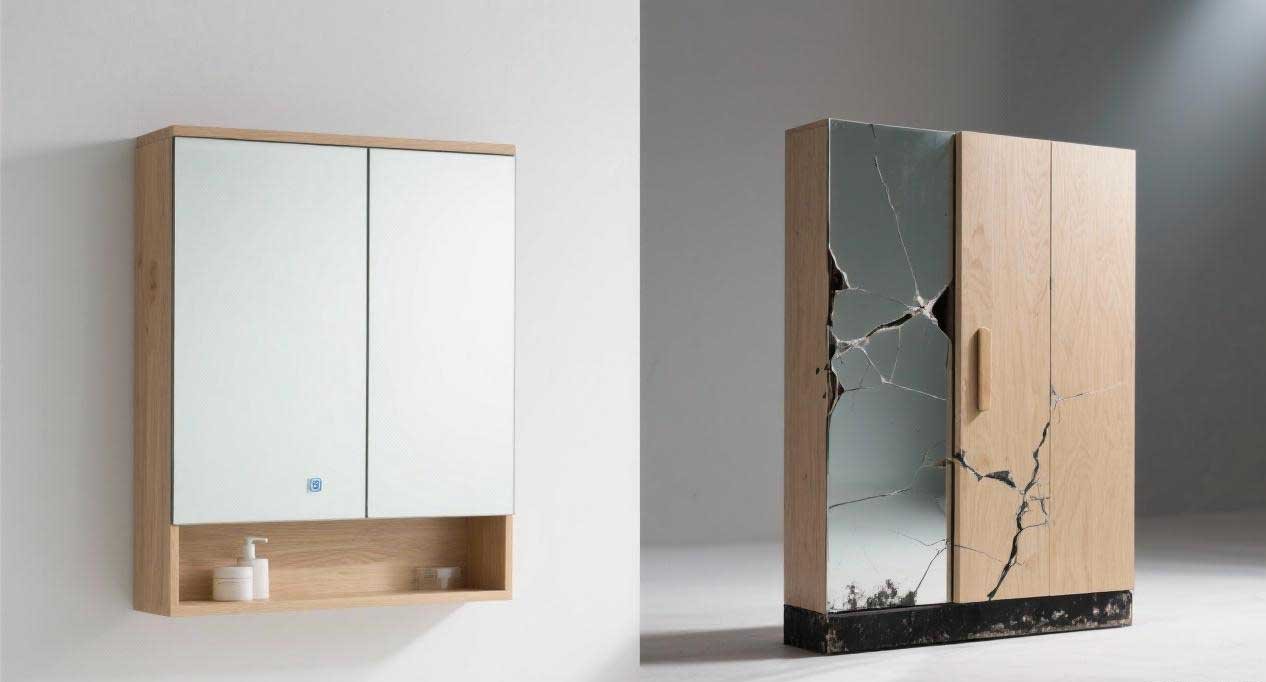
Written by David Chen – 18 years as a production and quality control consultant for bathroom furniture manufacturers anf Medicine Cabinet Factory, having audited over 200 factories across Asia for global buyers. This guide condenses two decades of on-ground experience into a actionable blueprint for your next sourcing decision.
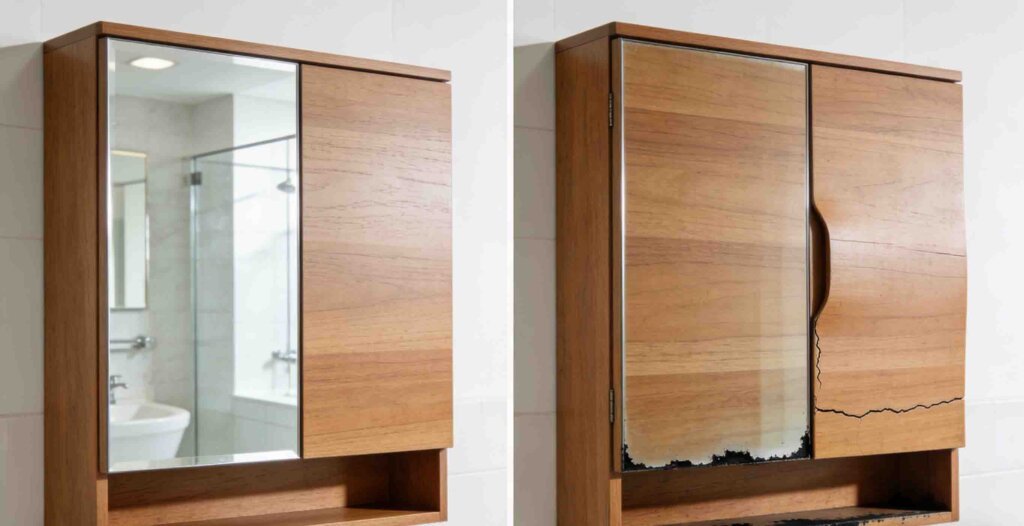
Here’s a scenario I’ve seen hundreds of times. You receive a beautiful sample of a wood medicine cabinet with mirror. The finish is smooth, the mirror is clear, and the price is right. You place an order for 500 units. Four months later, the container arrives. But upon opening, you find:
Suddenly, that “great price” evaporates under the weight of customer complaints, costly returns, and a damaged brand reputation. The root cause? It’s almost never bad luck. It’s a fundamental disconnect between what you saw in the sample and what you didn’t see happening on the factory floor.
The brutal truth in sourcing a wood medicine cabinet with mirror is this: two products can look identical in a showroom but have a 300% difference in lifespan. That difference is forged in the medicine cabinet factory, long before the product is ever packed. This article is your backstage pass. I will guide you through a virtual audit of a premier medicine cabinet manufacturer, revealing the 7 critical manufacturing stages that separate market leaders from ticking time bombs.
Why is this guide worth every minute of your read? Because the knowledge here is your most powerful financial risk management tool. Implementing this audit guide can save you tens of thousands in avoidable losses and forge a supplier partnership that drives your business growth for a decade. A split-image showing a perfectly finished wood medicine cabinet on one side, and a defective one with a warped door and corroded mirror edge on the other.
Every masterpiece begins with its raw material. For a wood medicine cabinet with mirror, the journey—and its ultimate durability—starts in the lumber yard and the drying kiln. This is where a professional medicine cabinet factory invests heavily in processes you’ll never see in the final product, but will absolutely feel years later.
When a supplier says “solid wood,” your first question should be: “What species and what grade?” This is the first filter in your audit.
A reputable medicine cabinet manufacturer won’t hesitate to provide detailed specifications. They understand that wood behaves differently in a humid bathroom in Florida versus a dry apartment in Arizona. Here’s a quick comparison of common woods used:
| Wood Species | Stability in Humidity | Hardness & Durability | Cost Implication | Best For |
|---|---|---|---|---|
| American Oak / European Oak | Very Good (if properly treated) | Very High | High | High-end, durable cabinets; accepts stains well. |
| Walnut | Good | High | Premium | Luxury, dark-finish cabinets; distinctive grain. |
| Maple | Good | High | Medium-High | Paint-grade cabinets; smooth, consistent finish. |
| Rubberwood | Moderate (requires excellent sealing) | Medium | Medium | Mid-range cabinets; eco-friendly (often plantation-grown). |
| Pine / Fir | Poor (soft, dents easily, moves a lot) | Low | Low | Rustic or very low-cost projects; requires careful engineering. |
Your Audit Action: Ask for the wood species specification in writing. During a physical or video audit, ask to see the raw material storage. Is it organized, off the floor, and protected from direct moisture? This speaks volumes about their baseline material management.
This is the single most critical, yet most overlooked, step. All wood contains water. If that water isn’t carefully and uniformly removed before manufacturing, the wood will move (shrink, swell, warp) after it’s in your customer’s bathroom.
A top-tier medicine cabinet factory will kiln-dry their lumber to a precise Moisture Content (MC) target, typically between 6% and 9%. But here’s the secret: the target isn’t arbitrary. It’s based on the Equilibrium Moisture Content (EMC) of the destination country or region.
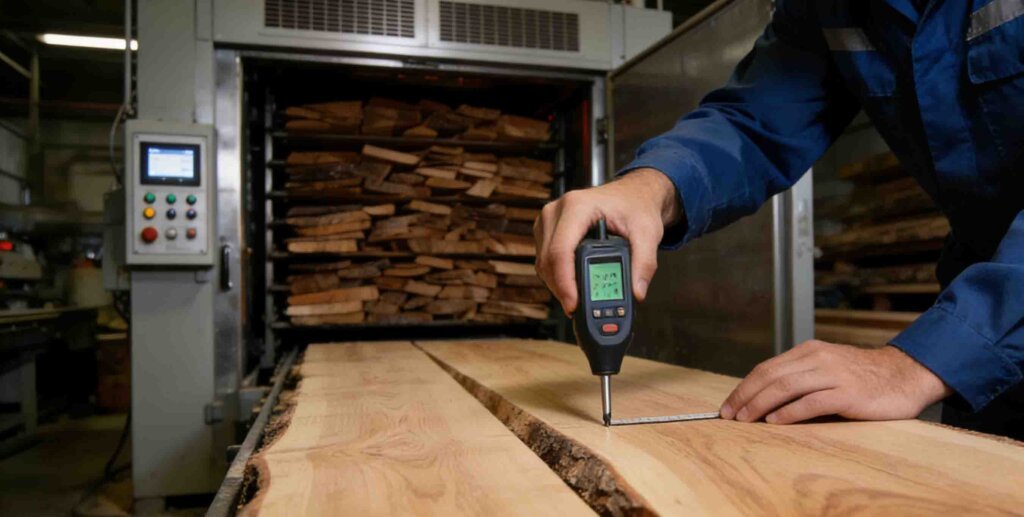
A professional factory will have kilns and, crucially, moisture meters. They should be able to show you records of drying schedules and spot-check results.
Your Audit Action: Request to see the kiln-drying facility and ask for a demonstration of moisture testing on random boards from their inventory. If they can’t provide this basic data, consider it a major red flag. They are essentially guessing at the stability of your wood medicine cabinet with mirror.A worker in a safety uniform using a digital moisture meter on a stack of oak planks inside a large, modern industrial kiln-drying room.
With stable wood in hand, the focus shifts to building a box that can withstand daily use, weight, and the stress of humidity cycles. This is where engineering and craftsmanship intersect.
How the corners of the cabinet box are joined determines its long-term structural integrity. Let’s break down the common methods:
The Professional Hybrid: The best medicine cabinet manufacturer often uses a hybrid approach. For example: Dowels for primary box corner alignment and strength, plus pocket screws for added reinforcement during clamping, plus high-quality PVA or PU wood glue. This combines precision, strength, and efficiency.
Your Audit Action: Ask for a “cut-away” sample or a disassembled defective unit to inspect the internal joinery. Don’t just ask “how are they joined?” Ask for the specific technique for the box, the door frame, and the shelving.
Joinery is one thing; assembling hundreds of cabinets exactly the same way is another. Consistency is king for hassle-free installation and customer satisfaction.
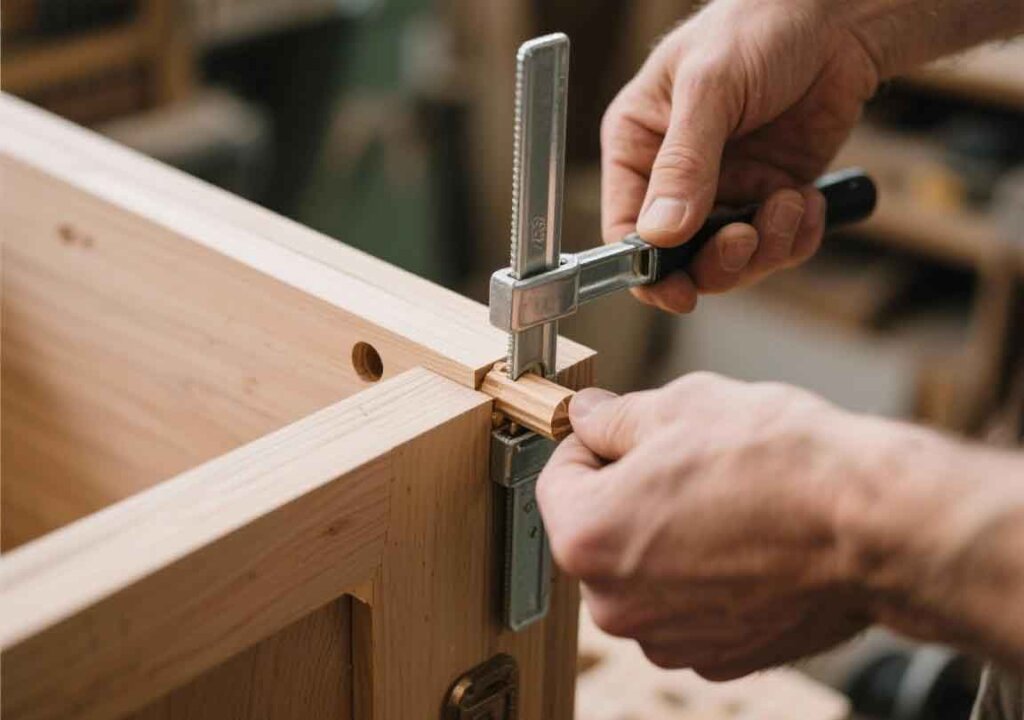
Look for the use of assembly jigs and fixtures. These are custom-made tools that hold parts in the exact correct position during gluing, doweling, or screwing. They ensure every cabinet box is square and every door hinge is placed in the identical spot.
A quality-conscious medicine cabinet factory will have a dedicated assembly station with pneumatic clamps, glue applicators, and immediate checks for squareness (using a large carpenter’s square or a diagonal measuring tool) before the glue sets.
Your Audit Action: Request to see the assembly line. Are workers using jigs and clamps, or are they simply free-handing screws? Ask about their “first article” inspection process—how do they verify the assembly process is correct before running the full batch?[A close-up shot of a wooden cabinet corner being assembled using a combination of wooden dowels and a pneumatic clamping jig in a clean, organized workshop.
Now we have a stable, sturdy box. The next stages define the product’s beauty, tactile feel, and its ability to survive the bathroom environment. This is where a wood medicine cabinet with mirror earns its price tag.
The finish is not just about color; it’s a waterproof, scratch-resistant, and UV-protective barrier. The process and environment are critical.
Key Steps in a Professional Finishing Line:
The Environment Matters: Finishing should be done in a dedicated, climate-controlled spray booth or room with positive air pressure to keep dust out. Ask about their filtration systems.
Your Audit Action: Ask to see the finishing area. Is it clean and separate from the dusty machining areas? Ask for Technical Data Sheets (TDS) for their coatings. Inquire about their testing for finish adhesion (cross-cut tape test) and resistance to common bathroom chemicals (e.g., toothpaste, alcohol).
The mirror is the focal point of any wood medicine cabinet with mirror. Its quality is non-negotiable.
Understanding Mirror Construction:
Your Audit Action: Ask the medicine cabinet manufacturer for their mirror supplier’s details and specifications. Perform a simple “breath test” on a sample: breathe heavily on the mirror. The fog should clear evenly and quickly. Inspect the cut edges closely under good light for any thin spots in the backing paint.[A cross-sectional diagram of a high-quality bathroom mirror, showing layers: glass, silver/aluminum reflective coating, copper layer, and multiple protective paint seals on the back and edges.
The product is made. Now, the final and crucial steps ensure it reaches your warehouse in the same condition it left the factory.
A sticker that says “QC Passed” means nothing without a rigorous process behind it. The best factories have dedicated QC stations with proper lighting (D65 daylight simulation lamps), inspection checklists, and functional testing areas.
They should be following a statistically valid sampling plan, often based on the AQL (Acceptable Quality Level) standard. For major defects (like structural issues, mirror defects), an AQL of 1.0 or 0.65 is common. This isn’t about checking every piece, but about having a scientific method to accept or reject a batch.
Your Audit Action: Ask to review a blank copy of their final inspection report. Ask to observe a live inspection. Do they check for:
If they can’t show you this process, your risk shifts from the factory floor to your receiving dock.
Packaging is the last line of defense. It must protect against:
Look for these elements in professional packaging:
Your Audit Action: Ask to see a fully packed unit. Drop it (gently) from a low height onto its corner. Does the packaging absorb the shock? Ask about their “drop test” standards for their cartons.
Take this list with you, either physically or on a video call. Print it. Use it.
Choosing a wood medicine cabinet manufacturer is not about finding the lowest price. It’s about de-risking your supply chain by partnering with a factory whose internal processes are as robust as the final product they promise.
This audit guide arms you with the questions that separate marketing from manufacturing reality. When you invest the time to look beyond the sample and into the medicine cabinet factory itself, you’re not just buying a product; you’re investing in predictability, quality, and peace of mind.
The manufacturers who welcome this level of scrutiny, like us at Havenseek Mirror, understand that our success is built on your success. We build transparency into our process because we have nothing to hide and everything to gain by being your long-term, reliable partner.
Put this guide to the test. Download our comprehensive, editable Factory Audit Checklist PDF, which includes all 10 points plus scoring and comment sections. It’s the same tool our own sourcing team uses.
Better yet, Schedule a Virtual Factory Tour with Havenseek Mirror. See first-hand how a professional medicine cabinet manufacturer operates. No smoke, no mirrors—just solid process.
Get Your Free Audit Checklist & Request a Live Tour Now
Focusing only on the finished product sample and the price. They neglect to investigate the processes that guarantee consistency across 500 or 5000 units: wood drying, joinery methods, and the QC system. A beautiful sample is a promise; the factory floor is the plan to keep it.
Very little. Within a single production batch, MC should not vary by more than 2%. For example, if the target is 8%, readings should ideally fall between 7% and 9%. Greater variation is a red flag for inconsistent drying, which leads to unpredictable warping or cracking.
Modern, high-quality water-based finishes can be excellent, offering good durability, low VOC, and fast drying. However, the absolute hardest, most chemical-resistant film often still comes from a premium solvent-based PU or a UV-cured coating. The key is to ask the medicine cabinet manufacturer for the specific product’s technical data and its tested resistance to water, alcohol, and abrasion.
Ask these three questions: 1) “Do you use aluminum-backed or silver-backed mirror?” (Aluminum is more corrosion-resistant). 2) “What is the process for sealing the cut edges?” (Look for multiple paint layers). 3) “Can you provide a salt spray test report for your mirror?” (A standard test for corrosion resistance). This forces them to provide technical proof, not just assurances.
Re-work and repair areas that are larger or busier than the main assembly line. A small, orderly repair station is normal. But if you see piles of defective doors, cabinets being stripped for refinishing, or many workers fixing mistakes, it indicates fundamental process failures upstream. Quality should be built in, not inspected and repaired in.
© 2024 Havenseek Mirror. All rights reserved. This article is based on professional experience and is intended for educational purposes to assist B2B buyers in making informed decisions.