Our Location
304 North Cardinal St.
Dorchester Center, MA 02124

Two buyers. Two seemingly identical tri-fold mirrors. One fails within a year; the other lasts a decade. The difference isn’t in the design you see—it’s in the standards you don’t. Here’s your 2026 insider’s guide to spotting the real deal.
You’re not just buying a mirror. You’re investing in a product that will face daily use, define a user’s experience, and reflect on your brand’s reputation. In the crowded world of tri folding mirror sourcing, the gap between a premium product and a problematic one is vast, yet often invisible at the quote stage. As a vanity mirror manufacturer that has audited dozens of component suppliers, I’ve seen brilliant designs ruined by subpar execution. This article is worth your next 15 minutes because it will save you thousands in hidden costs, endless headaches, and protect your client relationships by teaching you exactly what to look for beyond the spec sheet. We’ll move past glossy brochures and dive into the gritty, technical details that separate industry leaders from the rest.
Let’s be blunt. The global market for vanity mirrors is saturated. Most folding mirror supplier websites look the same. Quotes come in with similar dimensions and features. So, why do failure rates vary from less than 1% to over 10% in the first two years?
The answer lies in the manufacturing DNA—the protocols, tolerances, and material choices that never make it to the sales page. In 2026, focusing on these standards isn’t just about quality; it’s a critical financial and strategic imperative.
When you source under your brand or specify for a client, that tri folding mirror becomes an extension of your promise. A loose hinge, discolored LED, or peeling finish isn’t just a product flaw—it’s a breach of trust. In the age of online reviews and social media, a single batch of subpar mirrors can tarnish a reputation built over years.
My team’s analysis of after-sales data shows that over 80% of quality complaints stem from failures in the five “invisible” areas we’ll cover next. These are the battlegrounds where premium vanity mirror manufacturer operations distinguish themselves.
Not all glass is created equal. The mirror is the soul of the product, and its quality dictates the first impression.
High-end manufacturers source clear, ultra-white float glass from tier-1 producers. The cheaper alternative? Off-spec or recycled glass with subtle green tints (from iron content) and microscopic impurities. Under uniform LED lighting, this can cause uneven reflections and color distortion—a disaster for makeup application or salon work.
A spec sheet might say “4mm thick glass.” A quality-controlled process guarantees 4mm ±0.2mm. Why does variance matter? In a tri folding mirror, inconsistent panel thickness stresses hinges and can prevent wings from aligning flush. Flatness, measured with laser interferometers, is even more critical. A warped panel (even slightly) creates a funhouse distortion effect. The industry standard for premium mirrors is a flatness tolerance of less than 0.1mm over a 1-meter span.
The reflective coating isn’t just silver. It’s a sandwich of protection: a silver layer, followed by a copper layer to prevent corrosion, and multiple layers of protective paint. Cheap processes skip the copper or use thin, low-quality paint, leading to “black edge” corrosion—the ugly black lines that creep in from the edges within a few years, especially in humid bathrooms.
If the glass is the soul, the hinge is the heart. It’s the most mechanically stressed component.
A quality hinge in a tri folding mirror is designed for a minimum of 20,000 smooth open-close cycles. That’s over 27 years of daily use. Achieving this requires:
During factory audits, I don’t just look at the hinge sample. I ask to see the life cycle testing rig. A serious folding mirror supplier will have machines constantly opening and closing mirror wings, logging cycles until failure. This data-driven approach is what separates hope from engineering.
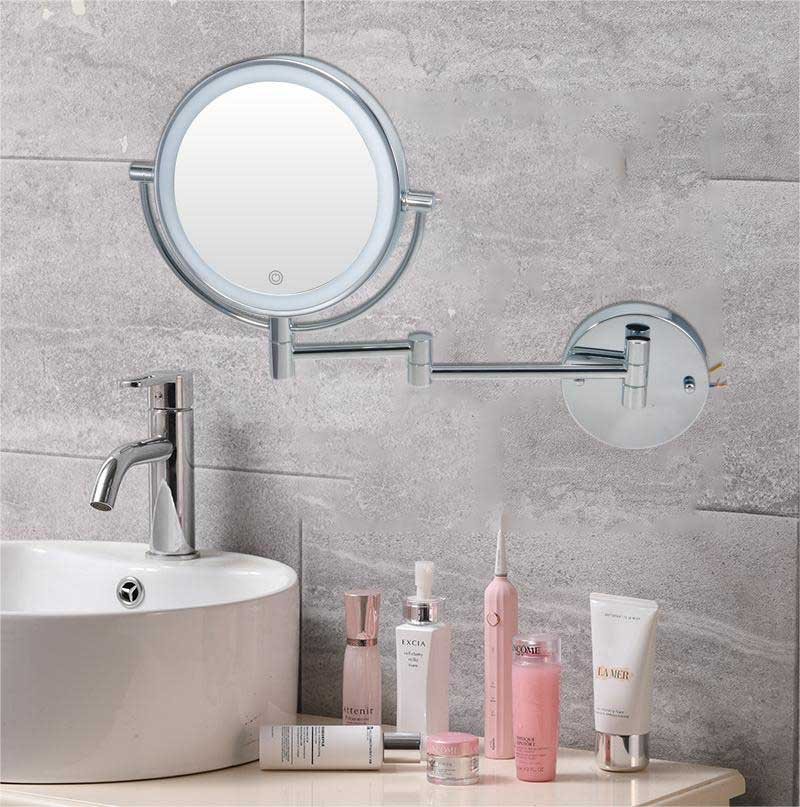
LEDs are commodities, right? Wrong. The implementation is everything. A great lighting system is about human perception, not just lumens.
For a vanity mirror manufacturer serving professionals, Color Rendering Index (CRI) is non-negotiable. CRI measures how accurately light reveals the true colors of objects. Standard LEDs have a CRI of 80. Premium vanity lights use LEDs with a CRI of 90+. The difference? At 80 CRI, makeup shades can look subtly off. At 90+, you see true-to-life color, crucial for precise application. This is a spec you must verify with a spectrometer on the sample.
Flickering light (even if imperceptible to the naked eye) causes eye strain and headaches. It’s a sign of a cheap, non-constant current driver. Premium drivers ensure flicker-free performance. Similarly, poor thermal design cooks the LEDs, causing premature “lumen depreciation” (dimming). Look for aluminum channels that act as heat sinks, visibly integrated into the mirror’s frame.
The light should wash evenly across the face. This requires precise diffuser design and strategic LED placement. A simple test: turn on the mirror in a dark room and hold a sheet of white paper in front of it. Any bright spots or dark bands are a fail.
How a mirror feels and ages is dictated by its finish. This is where the “premium feel” is manufactured.
A durable finish on a metal frame isn’t one coat of paint. It’s a multi-stage process: a corrosion-resistant base layer (often electrocoating), a perfectly applied color coat, and a clear topcoat for scratch and UV resistance. The industry benchmark for corrosion resistance is the salt spray test (ASTM B117). A quality finish should withstand 48+ hours without showing red rust. Many mass-produced items fail before 24 hours.
This isn’t just marketing. Regulations like EU’s RoHS and REACH restrict hazardous substances. A reputable manufacturer will provide test reports from accredited labs (like SGS) proving the absence of lead, cadmium, and specific phthalates in all materials—glass, paint, plastic, and electronics. This is critical for EU and North American markets.
This is the non-negotiable table stake. It protects the end-user and you, the importer.
Any credible tri folding mirror with lighting must have:
Red Flag: A supplier who says, “We can put any mark on the label you want,” is one to run from. Always ask for the actual test report and certificate number.
Knowledge is useless without action. Here is your field manual for evaluating any vanity mirror manufacturer.
Before visiting, request and verify:
Never judge a sample by looking at it. Tear it down. Use this checklist:
| Component | What to Check | Tool/Method |
|---|---|---|
| Glass & Reflection | Flatness, color tint, edge black line, coating uniformity. | Lay a straight edge across diagonal; view reflection of a grid pattern; inspect edges closely. |
| Hinge | Smoothness, torque consistency, noise, wobble at full extension. | Open/close 50+ times rapidly; hold a wing at 45°, check for sag; listen for grinding. |
| Frame & Finish | Seam gaps, coating smoothness, sharp edges, magnet strength (if applicable). | Run fingernail over seams; look for orange peel texture; use a cotton ball to catch snags. |
| Lighting | Color temperature, CRI, uniformity, flicker, dimming function. | Use a smartphone spectrometer app (like Photone); paper test for uniformity; slow-mo video for flicker. |
| Packaging | Corner protection, foam density, clarity of instructions. | Assess if it can survive a 1-meter drop. Is the foam low-density and crumbly? |
If visiting, don’t just tour the showroom. Ask to see:
Let’s make this tangible. A European hotel group (name withheld for NDA) was refurbishing 800 rooms. They needed a wall-mounted tri folding mirror with integrated LED lighting.
Two final folding mirror supplier candidates were shortlisted. Supplier A’s quote was 18% lower than Supplier B (Havenseek’s bid). On paper, their specs were identical: “4mm glass, LED, aluminum frame.”
Instead of choosing based on price, the procurement manager, using a framework similar to the one above, requested detailed test reports and conducted a blind sample “autopsy.”
The hotel chose Supplier B, paying the 18% premium upfront. Two years post-installation, their tracked failure rate is 0.4% (typical wear and tear). Industry data suggests products with the flaws found in Supplier A’s sample have an average 2-year failure rate of 8-12% in high-use environments.
The Cost Avoidance: On 800 units, a 10% failure rate would mean 80 failed mirrors. At a conservative $650 total cost per replacement (including parts, shipping, premium labor for a hotel technician, and administrative hassle), the potential hidden cost was $52,000. The initial “premium” paid was a fraction of that. This is the power of buying standards, not just products.
The Trap: Focusing solely on the FOB price per mirror.
The Solution: Adopt a Total Cost of Ownership (TCO) model. Factor in estimated failure rates (ask the supplier for historical data), warranty support efficiency, and the labor cost of replacements. A slightly more expensive, reliable mirror from a true vanity mirror manufacturer is almost always cheaper in the long run.
The Trap: Approving a sample that looks good on the surface but hasn’t been stress-tested.
The Solution: Mandate the destructive and functional testing outlined in the checklist above. Your pre-production sample is your contract for quality. If the supplier hesitates to provide a sample for rigorous testing, consider it a major red flag.
The Trap: Communicating only with sales, not engineering.
The Solution: Insist on a call or meeting with their technical or quality team before finalizing the order. Ask detailed questions about hinge mechanisms, LED driver sourcing, and their failure mode analysis. Their ability to answer confidently is a direct proxy for their competence.
A: Without a doubt, the hinge life cycle test. Hotel mirrors are opened and closed multiple times daily by guests, often not gently. A hinge rated for 20,000+ cycles from a reputable folding mirror supplier is essential. Ask for the test report data. Second is the salt spray test for the finish, given the humid bathroom environment.
A: Perform the “wiggle and listen” test. Open a wing halfway and gently try to wiggle it up and down and side-to-side. Excessive play indicates poor tolerances. Then, open and close it rapidly 20-30 times. Listen for any metallic grinding, clicking, or squeaking. A quality hinge should feel consistently dampened and silent.
A: It boils down to process control and investment in verification. A generic factory buys the cheapest components that meet a basic spec and assembles them. A premium manufacturer designs for lifetime performance, invests in in-house testing equipment (like life cyclers and spectrometers), and has a proactive quality control system that catches defects before they leave the line. They can also provide the data to back up their claims.
A: Be careful. For low-voltage products, a CE mark can be a self-declaration by the manufacturer. For mains-powered (plug-in) mirrors, it should be based on testing by a notified body. For greater assurance in North America, insist on an ETL or UL mark, which always requires testing by an OSHA-recognized laboratory (like Intertek or UL itself). Always ask for the test certificate.
A: Absolutely. While a factory may not offer extensive custom tooling for low MOQs, the core standards of material and component quality should be non-negotiable. A professional manufacturer will have a standard “quality grade” for their production line. Your leverage is your willingness to walk away and your clarity in specifying exactly which components must meet which standards (e.g., “LEDs must be CRI >90, brand X or equivalent”).
A: Vagueness. If they cannot or will not provide specific answers to technical questions (“What is the CRI of your standard LEDs?” “Can I see the hinge cycle test report?” “What is the thickness tolerance of your glass?”), or if every answer is “yes, we can do that” without asking clarifying questions, proceed with extreme caution. Expertise is specific.
Your next tri folding mirror project shouldn’t be a gamble. It should be a calculated, low-risk investment in quality and reliability. At Havenseek Mirror, we build these unseen standards into every product, because we know they are the only things that truly matter in the long run.
Put our 12 years of obsessive quality focus to work for you. Send us your specifications or project details, and we’ll provide not just a quote, but a full transparency package—including relevant test reports and a sample you can freely put through its paces.
Get Your Free Quote & Quality Audit PackageTypically provided within 12 working hours.