Our Location
304 North Cardinal St.
Dorchester Center, MA 02124


Written by Michael Thorne – Senior Project Consultant with Havenseek Mirror. For 15+ years, I’ve managed the export and on-site medicine cabinets with lighting installation coordination for over 10,000 premium lighted medicine cabinets. I’ve seen every installation mistake imaginable and helped hundreds of contractors turn a problematic bathroom upgrade into a flawless, profitable showcase.
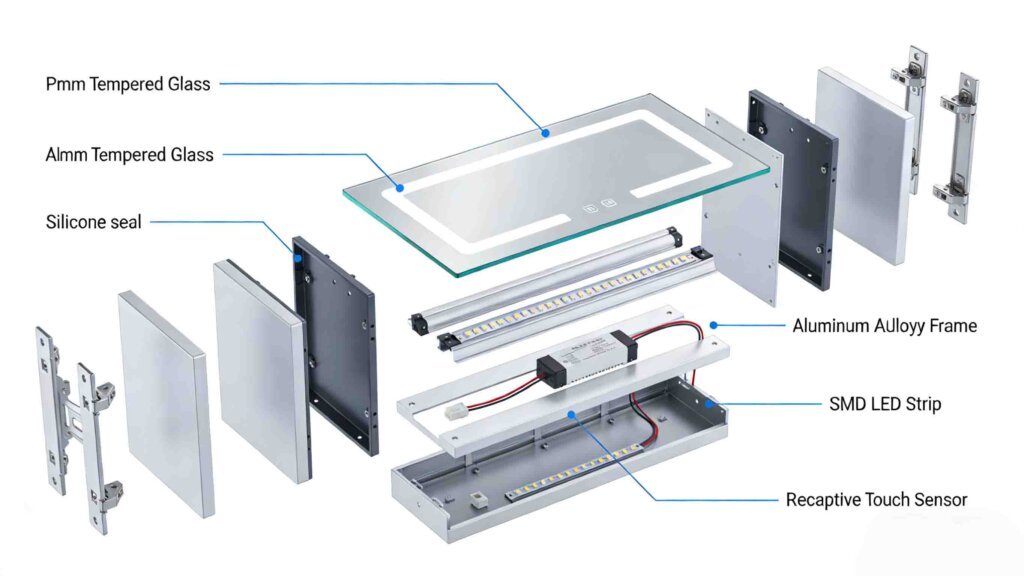
Let’s be brutally honest. A failed installation of a medicine cabinet with lighting isn’t just a minor inconvenience. It’s a cascading disaster. Imagine this: You’ve mounted a beautiful, $800 integrated-light cabinet in a luxury condo. Two weeks later, you get the dreaded callback. The cabinet is sagging, the lights flicker, and the client is furious. Now, you’re not just eating the profit from that job—you’re paying for a redo, damaging your reputation, and dealing with a stressed-out homeowner.
This scenario is heartbreakingly common, and it’s almost always preventable. The difference between a profitable, referral-generating install and a nightmare project lies in the details most guides gloss over. This article is different. Consider this your field manual for success.
We will move beyond basic “find the studs” advice. We’ll dive deep into the real-world challenges of installing modern medicine cabinets with lighting: managing integrated electricals, handling fragile mirrors on-site, and installing on tricky surfaces like tile. More importantly, we’ll solve the “what now?” problems, like a shattered mirror, by giving you clear steps on exactly where to buy replacement mirror for medicine cabinet units quickly and correctly.
Why is this guide worth your time? Because it’s built on 15 years of observing thousands of installations, both successful and catastrophic. I’ll show you how to turn a complex medicine cabinet with lighting from a liability into a standout feature that your clients will rave about. Let’s save you money, time, and stress.
Rushing to mount the cabinet is the number one cause of failure. The true installation work happens before the first tool comes out of the bag. This phase is about risk mitigation and preparation.
Not every medicine cabinet with lighting is suited for every wall. A heavy, solid-wood, illuminated cabinet requires fundamentally different support than a lightweight, surface-mount unit.
Pro Tip: For large or heavy cabinets (over 80 lbs loaded), insist on a French cleat mounting system. It distributes weight more evenly and makes solo or two-person hanging infinitely easier and safer.
Beyond a drill and level, professional installation demands specific tools. Showing up unprepared wastes hours.
| Tool Category | Essential Items | Why It’s Critical |
|---|---|---|
| Measurement & Layout | Laser level, stud finder (deep-scan capable), tape measure, pencil | A laser level ensures perfect horizontal alignment across long spans. A deep-scan stud finder can detect pipes and wires behind tile or thick drywall. |
| Power & Specialty Tools | Hammer drill (for concrete), variable-speed drill/driver, diamond-grit hole saw (for tile), 4-6″ hole saw (for plumbing/electrical) | Using a standard drill on tile will crack it. A hole saw kit is needed if you’re cutting a new opening in the wall for a recessed cabinet. |
| Electrical & Safety | Non-contact voltage tester, wire strippers, wire nuts, safety glasses, cut-resistant gloves | Always test for live wires before touching anything. Gloves protect your hands from sharp cabinet edges and glass. |
| Handling & Support | Panel lifter or suction cups, temporary support board (2×4), shims | Suction cups give you control when positioning the cabinet. A temporary ledger board screwed into studs holds the weight while you secure it. |
Never assume the product or site is ready. A 10-minute check can prevent a 10-hour disaster.
Now, with the site prepped, we execute. Follow this sequence to ensure a secure, level, and functional install.
For medicine cabinets with lighting, electrical is half the battle. Do this before the cabinet is heavy on the wall.
Critical First Step: TURN OFF THE POWER at the circuit breaker. Confirm it’s off with your voltage tester.
This is where structural integrity is decided. Choose your method based on your wall assessment.
Your mounting bracket must screw directly into the center of wall studs. Use 3″ long, #10 or #12 construction screws. For cabinets spanning between studs, you may need to install a horizontal wooden backer board between the studs first, then attach the bracket to that.
Avoid “Drywall Anchors” for Heavy Cabinets: Even heavy-duty toggle bolts have a risk of pulling out over time under constant load. They are a last resort, not a best practice.
1. Mark Your Hole: Use painter’s tape over the tile to prevent the drill bit from skating.
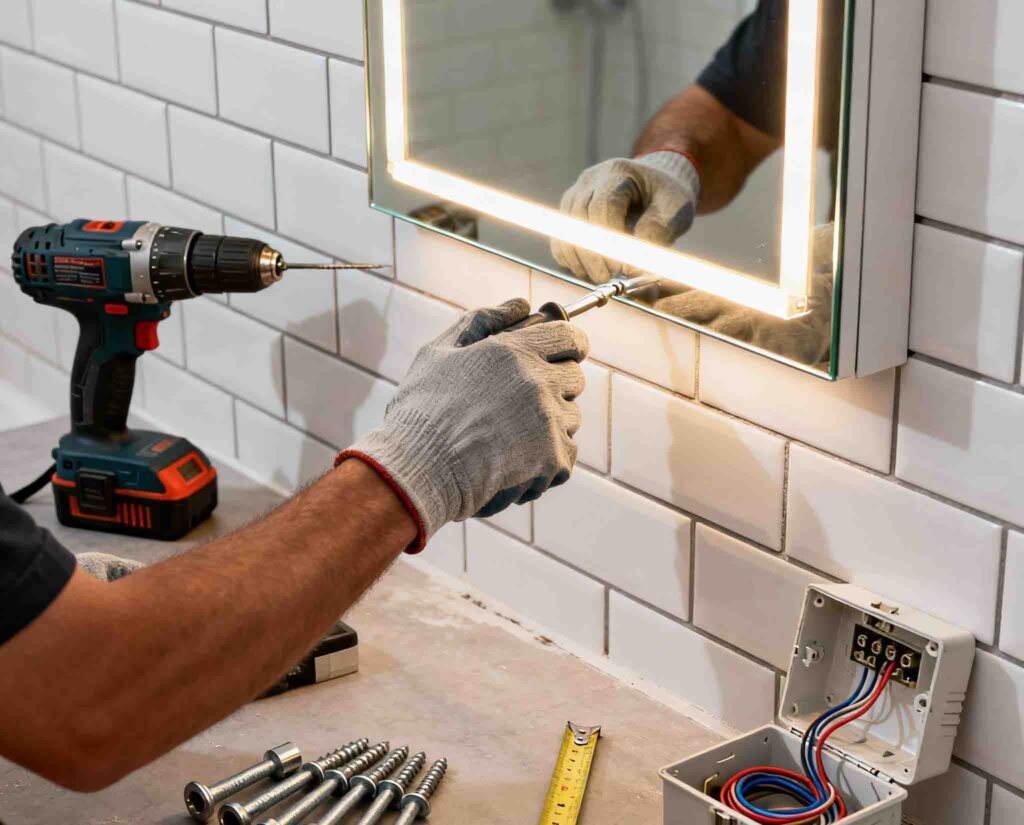
2. Drill Slowly: Use a diamond-grit hole saw or a spear-tipped tile bit. Apply steady, firm pressure with NO hammer action. Use water to cool the bit and reduce dust.
3. Anchor Choice: Once through the tile, switch to a masonry bit for the wall behind. Use a high-quality sleeve anchor designed for the combined thickness of your tile and substrate.
A hammer drill and concrete screws (Tapcons) or sleeve anchors are required. Drill your hole slightly deeper than the anchor length to avoid dust buildup. Use a vacuum or blower to clean the hole before inserting the anchor.
With the bracket secure, the final step is placing the cabinet itself.
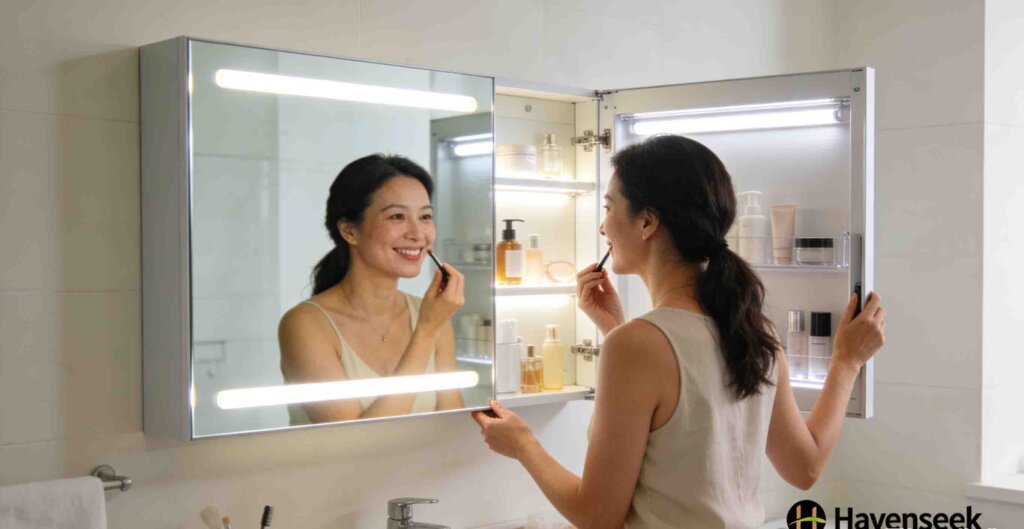
The job isn’t done when the cabinet is on the wall. Professional follow-through prevents callbacks and builds trust.
Go through this list before you pack your tools:
Spending 2 minutes educating the client extends the life of the product and reduces warranty calls for your medicine cabinet supplier.
What to Tell Them: “To keep your new medicine cabinet with lighting looking great, use only a soft, damp cloth with mild soap or a dedicated glass cleaner sprayed on the cloth—never directly on the mirror. Avoid abrasive cleaners. For the frame, just wipe with a damp cloth.” This simple advice prevents chemical damage to mirror edges and finishes.
LEDs are reliable, but problems happen. Here’s your diagnostic tree:
| Symptom | Likely Cause | Solution |
|---|---|---|
| Lights don’t turn on | Power connection loose, faulty driver, or tripped GFCI. | 1. Check wall switch and GFCI outlet. 2. Re-check wire connections in the junction box. 3. Contact the medicine cabinet supplier for a replacement driver. |
| Lights flicker or buzz | Incompatible dimmer switch or loose neutral wire. | 1. Ensure dimmer is LED-compatible (MLV/ELV). 2. Tighten all wire connections, especially neutral (white). |
| Partial lights out | A single LED strip or section has failed. | This typically requires replacing a light module. Contact your supplier with the cabinet model number. |
A broken mirror is a stressful, messy problem. Acting quickly and correctly is key. First, safety is paramount. Tempered glass shatters into small, relatively safe cubes, but wear heavy gloves and eye protection during cleanup.
The real challenge is where to buy replacement mirror for medicine cabinet that perfectly matches the original. You have three options, each with trade-offs:
Replacement Process: Once you have the new glass, carefully remove the broken pieces from the door frame (usually held by adhesive or small clips). Clean the frame channel thoroughly. Apply a high-grade silicone adhesive recommended by your glass provider, set the new mirror, and allow it to cure fully (usually 24-48 hours) before rehanging the door.
Installing a high-quality medicine cabinet with lighting should be the finishing touch that elevates a bathroom, not the start of a headache. By treating the installation with the respect it demands—meticulous planning, using the right techniques for your wall, and knowing how to solve problems like a broken mirror—you transform a simple fixture into a lasting asset.
Your reputation as a contractor is built one installation at a time. A flawlessly installed cabinet leads to client referrals and repeat business. Remember, your relationship with a knowledgeable medicine cabinet supplier is a crucial part of this process. A good supplier provides clear installation guides, responsive technical support, and reliable access to parts like replacement mirrors.
Take these practices to your next job. The few extra minutes spent in the pre-installation phase will save you hours of frustration and protect your hard-earned profit.
Installing dozens of medicine cabinets with lighting in a hotel or condo project? Need a reliable source for a hard-to-find replacement mirror for a medicine cabinet? Havenseek Mirror’s project consultants are here to help. We provide detailed CAD drawings, pre-installation spec sheets, and direct technical support to ensure your large-scale install goes smoothly.
Get Your Free Project Consultation & Quote in 12 Hours
Q: What should I do if the medicine cabinet I received from the supplier has damaged lighting?
A: Document the damage immediately with clear photos. Do not proceed with installation. Contact your medicine cabinet supplier directly with the photos and your order number. Reputable suppliers like Havenseek Mirror will typically expedite a replacement lighting component or entire unit at no cost. Installing a damaged unit voids warranties and creates liability.
Q: Are there special cleaners I should use on the mirror and frame?
A: For the mirror, use a standard, non-abrasive glass cleaner. Key tip: Spray the cleaner onto a soft microfiber cloth first, not directly onto the mirror. This prevents liquid from seeping behind the glass and damaging the reflective backing or lighting components. For metal frames, a damp cloth is usually sufficient. Avoid acidic or abrasive cleaners on any finish.
Q: Can I install a recessed medicine cabinet with lighting in a wall with existing plumbing pipes?
A: It is possible but requires extreme caution. You must know the exact path of the pipes. Use a stud finder with pipe detection and consider making a small exploratory hole. The cabinet’s rough-in depth must be greater than the depth of the pipes plus the drywall. If the pipes are in the way, you cannot install a recessed cabinet there—a surface-mount model is your only option.
Q: How much weight can a properly installed medicine cabinet with lighting hold on its shelves?
A: This varies greatly by model and shelf material. Glass shelves typically hold 20-40 lbs distributed evenly. Solid wood or reinforced shelves may hold more. Never exceed the manufacturer’s stated weight limit. Overloading shelves can stress mounting points and cause failure. This information should be provided by your medicine cabinet supplier.
Q: Is it difficult to replace the LED lights in a medicine cabinet if they burn out?
A: In modern, quality cabinets, the integrated LED arrays are designed to last 25,000+ hours and are often not user-replaceable. If they fail prematurely, it’s usually the driver (power supply) that needs replacing, which is a simpler component swap. Always check the warranty with your supplier first. For cabinets with standard bulb sockets, replacement is as easy as changing any household bulb.
To support the information in this guide and help you continue your research, here are valuable resources from leading industry authorities: