Наша локация
304 Норт Кардинал Ст.
Дорчестер Центр, Массачусетс 02124

Written by Marcus Chen – 15 years Senior Engineering Director & Export Manager in Chinese mirror manufacturing, having served 800+ hospitality and commercial clients across 50 countries.
The global commercial real estate and hospitality supply chain is facing an unprecedented compliance transformation as we approach 2026. A staggering number of high-end architectural and bathroom lighting imports encountered catastrophic customs delays at major European and North American ports last quarter alone. The primary culprits for these massive financial losses? Fraudulent electrical safety certificates, non-isolated driver components, and substandard waterproofing mechanisms. If you are importing architectural materials, guessing about regulatory compliance is no longer a viable corporate strategy. Successfully executing UL certified LED mirror wholesale operations requires deep technical intelligence and an unyielding supply chain verification process.
I have spent over fifteen years walking automated production facility floors, correcting severe structural defects, and resolving catastrophic commercial project failures for B2B buyers who mistakenly optimized for upfront unit prices over verified engineering quality. In my professional experience, understanding the rigorous mechanics of genuinely CE approved bathroom mirrors is the single most effective shield protecting your hard-earned corporate margins. This exhaustive engineering blueprint will expose the hidden vulnerabilities commonly found in bulk container shipments, outline the strict chemistry of anti-corrosion glass technologies, and reveal exactly how to audit an IP44 LED mirror manufacturer before deploying significant capital.
Why is this 3,000-word guide worth your time? Consider this the equivalent of an $800 professional engineering consultation. By the time you finish reading, you will possess a bulletproof framework for B2B smart mirror sourcing, ensuring your next hospitality bathroom mirror supply contract passes every single municipal inspection smoothly and profitably.
Before analyzing the internal engineering of illuminated glass fixtures, procurement teams must master the baseline operational requirements of international markets. You must evaluate suppliers based on hard data, not polished sales catalogs.
| Engineering Parameter | North American Market (USA & Canada) | European Union & UK Market |
|---|---|---|
| Primary Electrical Framework | UL 962 / cULus Listing (Full Assembly Approval) | EN 60598-1 & CE/UKCA Mark Validation |
| Ingress Protection Standard | NEC Damp Location Certification Minimum | IP44 Minimum Rating (Validated for Zone 2) |
| Substrate Chemistry | 5mm Copper-Free, Shatterproof Backing Film | 5mm Eco-Friendly, Heavy-Metal Free Silver |
| Driver Architecture | Class 2 Power Supply, Fully Isolated Low-Voltage | SELV (Safety Extra Low Voltage) Compliant |
Sourcing commercial hardware demands a strict, uncompromising understanding of international bathroom mirror safety standards. Customs inspection agencies globally have integrated automated algorithmic profiling to analyze incoming shipping manifests. Shipments categorized as high-risk electronic goods—such as unverified illuminated vanity fixtures—are systematically flagged for physical testing at ports of entry.
The North American commercial real estate sector is built firmly around the strict boundaries of the UL 962 compliance mirror standard. This mandate does not treat the illuminated mirror as a simple, interchangeable lighting fixture; it legally classifies it as a comprehensive electrical structural furnishing. Field inspectors look for mechanical stress resistance, flame-retardant backing materials, structural load capacities, and robust grounding networks.
Conversely, exporting to European territories requires rigorous alignment with the EN 60598 luminaire specifications. European regulatory bodies demand a completely accessible Technical Construction File (TCF) detailing Electromagnetic Compatibility (EMC) compliance and Low Voltage Directive (LVD) verification. When you plan to import LED mirrors to Europe/USA, omitting these precise technical dossiers ensures immediate shipment rejection.
Hotel bathroom facilities represent an incredibly aggressive environment for delicate electrical engineering. The continuous cycle of high-humidity steam accumulation paired with cold air-conditioned drafts causes heavy internal condensation. Utilizing a standard IP20-rated alternative exposes the interior electronic components directly to moisture ingress, triggering premature driver decay.
Contracting exclusively with a legitimate, vetted IP44 LED mirror manufacturer ensures that every single internal electronic module is physically sealed against liquid splashes from any operational angle. Utilizing a specialized waterproof junction box mirror configuration perfectly encapsulates the line-voltage connections, entirely neutralizing the risk of moisture bridging. This specific level of defensive product design separates fragile retail-grade units from bulletproof commercial grade vanity mirrors.

A flawless, glowing mirror surface can easily mask severe architectural compromises hidden directly behind the glass pane. To protect your brand’s financial health, your quality control personnel must move beyond superficial cosmetic inspections and actively evaluate the underlying raw material chemistry.
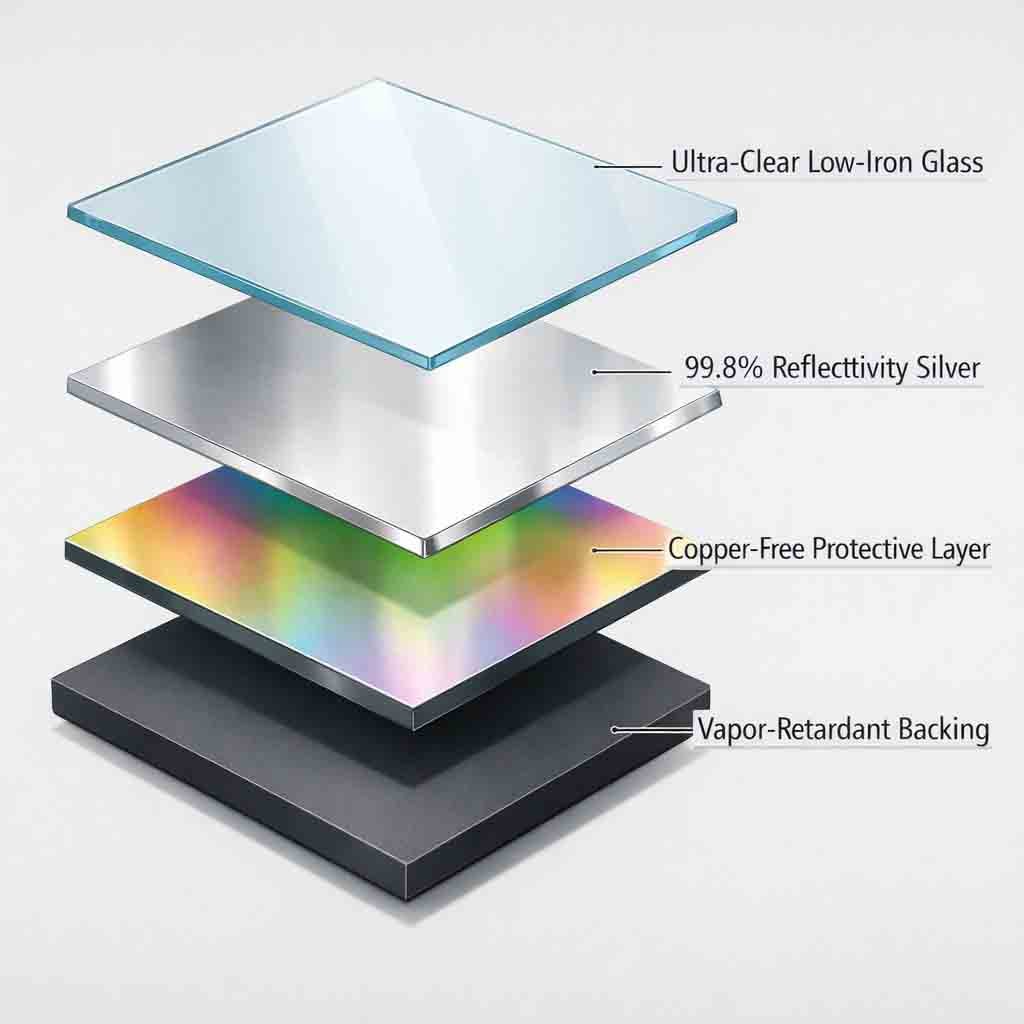
A major failure mechanism plaguing commercial procurement firms is the rapid development of dark, unsightly oxidation tracking along the mirror borders, commonly known in the industry as the “black edge” effect. In high-traffic hospitality spaces, volatile cleaning chemicals and airborne moisture penetrate the glass edges, initiating a destructive galvanic reaction within traditional copper backing layers.
This exact chemical engineering upgrade successfully protects the long-term asset value for hospitality operators during multi-year property lifecycles, ensuring the hotel bathroom renovation mirror specs meet rigorous design standards.
The structural reliability of an illuminated vanity unit is bound entirely to its power management network. An engineered, commercial-grade low-voltage LED mirror driver cleanly steps down dangerous primary line power (110V/220V) into a safe, ultra-stable 12V or 24V direct current. This isolation barrier safeguards the end-user while mitigating thermal stress on the light-emitting components.
The global manufacturing ecosystem contains sharp operational discrepancies. While elite facilities follow immaculate engineering standards, the market simultaneously battles a massive influx of doctored compliance files and counterfeit test reports. B2B wholesale buyers must implement a strict validation architecture.
The most common documentation scam involves a factory producing a genuine, verified UL or CE listing certificate—but a closer look reveals the file belongs only to a third-party raw LED strip or a standalone power block, not the complete, unified mirror assembly. When a commercial electrical inspection mirror audit is initiated by local municipal officers, the entire installation fails.
Before executing a high-volume wholesale smart mirror contract, your third-party quality control agency must physically audit the facility floor. Never rely exclusively on polished digital marketing assets or virtual WeChat video tours. Demand to see these five structural pillars:
Procuring uncertified electrical components extends far beyond a simple border-clearance headache; it constitutes an active, severe threat to corporate liability. Within the commercial construction sectors, the downstream costs linked to unverified, low-tier sub-components can rapidly bankrupt an unprepared distribution firm.
Consider a highly realistic commercial scenario: A distributor delivers 500 custom-backlit units for a major luxury resort renovation project. The physical installation is completed smoothly by local contractors. However, during the final official building inspection, the municipal electrical marshal notices the high-lumen bathroom vanity mirror units lack a unified, valid UL listing label.
The building’s final electrical safety sign-off is instantly denied. The developer cannot obtain a Certificate of Occupancy, delaying the entire resort launch. Under standard commercial indemnity clauses, the distributor faces severe liquidated damages covering lost guest room revenue, compounding labor charges to uninstall the non-compliant hardware, and emergency air-freight fees to procure legitimate, certified replacements from a reliable custom hotel mirror manufacturing provider.
Beyond the complexities of electrical compliance, physical transport vulnerability represents a constant threat to profit margins. Architectural glass is structurally delicate, and the physical stress of ocean freight transit introduces massive mechanical vibrations.
A classic, fatal error in high-volume sourcing is focusing exclusively on the initial per-unit factory price quotation. Experienced procurement directors look far beyond this surface metric, evaluating OEM smart mirror manufacturer partners based on Total Cost of Ownership (TCO).
Let us run a simple financial analysis. A procurement officer saves $15 per unit by selecting an unverified workshop over an established, certified supplier for a 1,000-unit B2B mirror import customs clearance order. The initial paper savings appear attractive at $15,000.
However, twelve months following project delivery, the low-tier non-isolated drivers begin encountering high thermal failure rates in the field. Dispatches to replace a single internal component inside a commercial property cost an average of $150 in local union electrician fees. If merely 15% of those cheap units fail, the repair bills quickly hit $22,500, entirely wiping out the original savings while permanently destroying the firm’s professional standing with the developer.
To successfully scale an architectural distribution enterprise, your business requires a deeply competent manufacturing ally rather than a basic trading intermediary. A highly mature entity like Havenseek Mirror manages the intricate headaches of design engineering, international laboratory testing, and automated quality control internally.
Stop risking your enterprise brand equity and project deadlines on unvetted trading houses and unverified component certifications. Partner with Havenseek Mirror to access elite, fully certified, heavily engineered commercial LED mirror wholesale lines that pass every field inspection seamlessly.
Request Free Sample & Compliance Audit Now