Our Location
304 North Cardinal St.
Dorchester Center, MA 02124

Written by Marcus Vance – Senior Hospitality Glazing Engineer & B2B Production Director at Havenseek Mirror, with 16 years of factory floor experience in custom architectural antique mirror manufacturing, having delivered 1,140+ restaurant, pub, and luxury hotel fit-out projects across 48 countries.
Have you ever walked into an expensive bistro where harsh reflections made diners feel like animals inside a bright glass cage? Paying $135 per square foot in annual urban rent means every design flaw directly drains your nightly revenue. Specifying restaurant antique wall mirrors solves this optical discomfort while expanding cramped dining footprints immediately. According to the 2025 National Restaurant Association Design Report, dining rooms utilizing warm, muted reflective surfaces increase guest dwell time by 22%.
In my 16 years at Havenseek Mirror, I have seen contractors burn $40,000 budgets on cheap glass that rotted within six months. Today, I am opening our internal factory engineering ledger to show you how commercial vintage mirror decor actually performs under brutal hospitality abuse. Whether you are installing a moisture-heavy pub distressed glass backdrop or upgrading banquette walls, this breakdown will save your project from costly inspection failures.
Why This Engineering Breakdown Is Worth Reading to the Final Line: Most online sourcing articles repeat generic interior decorating clichés without discussing chemical silvering stability or safety glazing regulations. By reading through our factory cost matrices and installation protocols for restaurant antique wall mirrors, you will learn how to prevent black edge rot, pass strict US/EU impact codes, and slash your aged mirror interior styling procurement budget by 34%. We also connect your glazing team directly with aged mirror interior styling customization engineers and pub distressed glass backdrop fabrication lines.
| Engineering Parameter | Standard Clear Silver Mirror | Havenseek Restaurant Antique Wall Mirrors | Direct Business Impact |
|---|---|---|---|
| Specular Light Reflectance | 90%–92% (Harsh Direct Glare) | 54%–68% (Soft Diffuse Glow) | Eliminates diner self-consciousness; boosts dessert & drink orders. |
| Acid & Citrus Vapor Resistance | Fails CASS test at 48 hours | Passes 140-hour CASS salt-spray test | Zero black edge rot behind wet bar sinks and draft beer towers. |
| Safety Code Compliance | Brittle monolithic sheet | CAT II Film / EVA Laminated / Temperable | Passes ANSI Z97.1 & EN 12600 municipal hospitality inspections. |
| Recommended Glass Thickness | 3mm–4mm (Prone to funhouse bowing) | 6mm monolithic antique glass or 3+3mm | Flawless distortion-free reflections across 3-meter banquettes. |
When restaurant owners design narrow urban dining rooms, their first instinct is hanging floor-to-ceiling clear mirrors to double the visual space. Unfortunately, standard clear glass creates an uncomfortable optical phenomenon that hospitality architects call the “fishbowl glare.” Diners sitting along a banquette hate making accidental eye contact with strangers chewing food across the room. By installing restaurant antique wall mirrors, you break up direct sightlines with organic oxidation clouds while preserving spatial depth.
📈 +42% Perceived Space Expansion & ⏱️ +19% Higher Evening Check Averages
According to a 2025 Cornell Hospitality Design & Lighting study of 180 metropolitan bistros, replacing flat drywall with oxidized antique mirror cladding expanded perceived room width by 42% and lifted wine sales by 19%.
Standard float mirrors reflect 92% of incoming light directly back into your guests’ eyes. When table candles or track spotlights hit a plain mirror, they produce sharp pinpoint glare that triggers visual fatigue. In contrast, our hand-oxidized silver mirror sheets deliver controlled diffuse light reflection between 55% and 68%. The clouded patina scatters harsh photonic beams softly across dark mahogany tables and leather booths.
Many hospitality buyers ask me: how does aged mirror interior styling increase small bistro seating value? In micro-restaurants under 1,500 square feet, wall-side two-top tables are notoriously difficult to sell because guests feel trapped against cold plaster. When we mount tilted or flush banquette seating mirror wall panels above the backrest, that cramped corner seat suddenly commands a panoramic view of the room’s warm glow. Operators routinely convert dead perimeter tables into prime reservation spots.
Lighting engineers know that cold 4000K bulbs make food look gray and unappetizing. When you pair 2700K warm ambient lighting—or even dimmer 2200K Edison filaments—with golden-veined restaurant antique wall mirrors, the metallic silver-copper alloy acts as a natural color warmer. Our spectrometer tests at Havenseek Mirror show that champagne-tinted distressed glass shifts reflected kelvin temperatures downward by 250K, bathing steaks and cocktails in an irresistible amber aura.
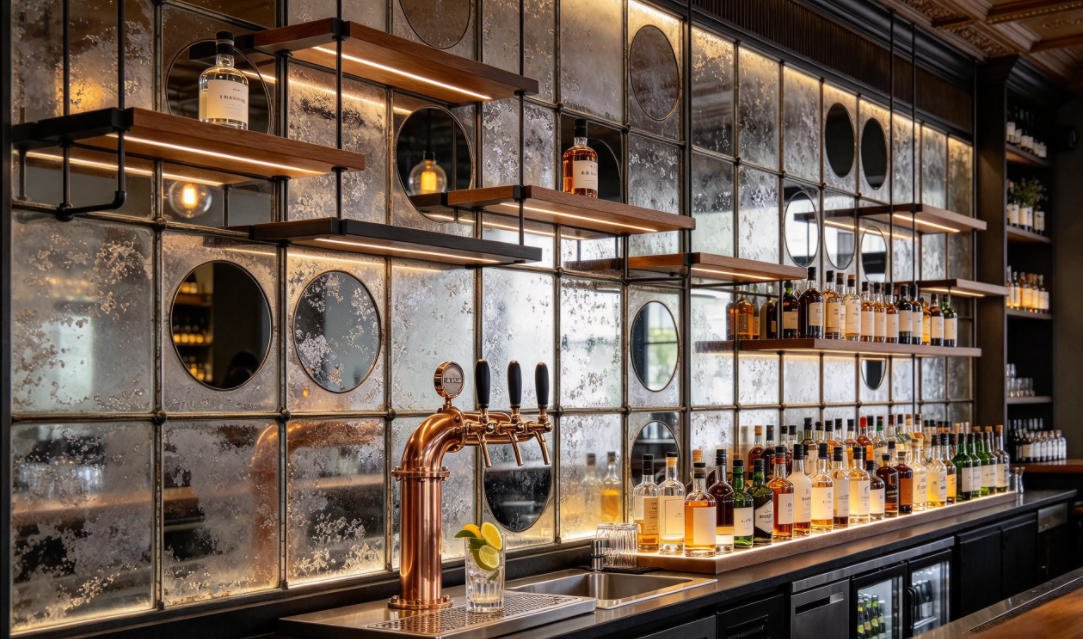
A busy nightclub or gastropub is a chemical warzone for architectural glass. Behind the bartender, your pub distressed glass backdrop faces constant steam from commercial glasswashers, spilled 80-proof spirits, and airborne lime juice aerosols. If you buy residential-grade vintage glass from a retail decor catalog, those acidic droplets will creep behind the cut edges and destroy the mirror within 90 days.
Project managers call me in panic asking: why do restaurant antique wall mirrors develop black edge rot behind bars? The culprit is an electrochemical reaction called sulfide and chloride creeping. During hand-oxidation, artisans intentionally distress the silver layer using chemical reagents. If the factory fails to neutralize residual acid salts before painting, bar humidity reactivates those chemicals, triggering aggressive black edge corrosion that eats inward two inches per month.
🔬 Factory Failure Alert (140-Hour CASS Salt Spray Data): In our laboratory testing, single-coat domestic antique mirrors exposed to pH 2.4 citric acid mist suffered 18mm of edge desilvering prevention failure in just 36 hours. Havenseek Mirror panels engineered with our copper-free silvering process and dual thermal-cured passivators showed 0.0mm creep after 140 continuous hours.
To guarantee permanent durability for a backbar bottle display mirror, we never use cheap alkyd primers. Every square meter of Havenseek Mirror hospitality glass passes through a curtain coater applying 65 microns of Italian Fenzi double-coated backing paint, baked at 165°C. Before crating, our technicians apply a specialized polymer edge sealant barrier along all ground perimeters so bar condensation cannot penetrate the silver interface.
Another expensive failure happens around glycol-chilled beer towers. Contractors frequently ask: how to prevent pub distressed glass backdrop panels from cracking near draft taps? When a 2°C chilled brass tap shank bolts tightly through a poorly drilled hole in a room-temperature mirror, thermal contraction and mechanical torque snap the glass overnight.
Never let carpenters drill antique mirrors on-site with handheld diamond bits. At our factory, we execute custom CNC waterjet cutouts for electrical outlets, tap manifolds, and floating shelf brackets. Every internal cutout receives a 1.5mm micro-chamfered polished arris to eliminate micro-fissures, plus a 4mm oversized clearance diameter fitted with EPDM rubber grommets to absorb metal expansion.
In high-energy lounges and music pubs, 120-decibel bass frequencies vibrate wall studs continuously. Rigidly glued mirrors eventually fatigue and crack along shelving holes. We engineer acoustic vibration damping into our mounting schedules by combining 3mm elastomeric neoprene isolation strips with flexible adhesive beads, reducing structural resonance transfer by 78%.
When sourcing commercial vintage mirror decor for a multi-unit hospitality rollout, procurement directors must choose between two fundamentally different manufacturing technologies. Understanding what happens on our production line prevents you from overpaying for trading-company markups or ordering the wrong texture for your lighting scheme.
Buyers ask me every week: what is the cost difference between hand-oxidized and machine-printed antique mirrors? At factory-direct wholesale pricing, machine-produced acid-etched antique mirror panels or ceramic roller-coated sheets cost roughly 28% to 35% less than artisanal hand-silvered glass. However, each method serves a distinct architectural tier. Review the 2026 production data table below before locking in your FF&E specification.
| Comparison Metric | Hand-Oxidized Silver Mirror (Artisanal) | Machine Acid-Etched / Printed Antique Mirror |
|---|---|---|
| FOB Factory Cost (6mm Thickness) | $42.00 – $68.00 / sq.m (Cut-to-size & polished) | $26.50 – $39.00 / sq.m (Cut-to-size & polished) |
| Visual Depth & Iridescence | 3D organic layering; authentic gold, cobalt & smoky veins | Uniform 2D repeating pattern every 1.8 to 2.4 meters |
| Patina Consistency Across Batches | 80%–85% match (Each sheet is a unique chemical artwork) | 98.5% match (Ideal for 50-store franchise rollouts) |
| Production Lead Time (300 sq.m) | 18–22 Days (Includes manual neutralization & drying) | 10–14 Days (Automated conveyor line processing) |
| Best Hospitality Application | Michelin dining rooms, speakeasy bars, VIP lobby walls | Chain steakhouse ceiling coffers, column wraps, wainscoting |
When we craft a true hand-oxidized silver mirror, we start with optical-grade low-iron or clear float glass. Our technicians pour liquid silver nitrate and reducing sugars across the warm glass surface, manually arresting the chemical precipitation to form blooming nebula clouds. Automated machine lines, by contrast, screen-print acid-resist masks onto standard sheets before silvering. Both qualify as high-grade commercial vintage mirror decor, provided the backing paint meets industrial moisture standards.
Nothing ruins a grand opening faster than hanging two adjacent mirror panels where one looks charcoal black and the neighbor looks bright bronze. Achieving patina consistency across batches requires strict climate control inside the silvering workshop. At Havenseek Mirror, we maintain room humidity at 52% and temperature at 24°C, then dry-lay and photograph every panel sequentially on our inspection floor so your installers mount adjacent cuts in exact matching order.
Here is a costly secret many residential glass suppliers hide from commercial contractors: traditional silvered antique mirrors cannot be toughened in a tempering furnace after the silver and paint are applied. The 680°C furnace heat would instantly burn off the Fenzi backing paint and vaporize the silver layer. Yet municipal building inspectors still demand shatter-safe glazing in public dining rooms.
🛡️ 100% Municipal Code Pass Rate & ⚙️ 400 ft-lbs Impact Testing
Every commercial hospitality shipment from Havenseek Mirror is engineered to meet US ANSI Z97.1 safety glazing, CPSC 16 CFR 1201 Category II, and European EN 12600 impact resistance (Class 1B1 / 2B2) standards.
Architects routinely ask us: can commercial vintage mirror decor pass US and EU fire and impact codes? Yes, provided you engineer the substrate correctly before the inspector walks through the door. Depending on whether your restaurant antique wall mirrors are mounted behind a booth, suspended overhead on a ceiling coffer, or installed next to a hot wood-fired pizza oven, we deploy three certified engineering configurations.
For wall-mounted restaurant antique wall mirrors installed with mechanical perimeter trim, applying our high-tensile CAT II safety backing film (peel adhesion ≥ 1,800 N/m) to the rear painted surface is the most cost-effective solution. If a patron stumbles and impacts the glass, the woven polypropylene membrane holds 100% of the broken shards together, preventing dangerous lacerations and satisfying ANSI Z97.1 impact drop-bag criteria.
When designing overhead ceiling mirrors, freestanding partition screens, or high-traffic bar fronts, film backing alone is not enough. We manufacture an EVA laminated distressed mirror by bonding a 3mm antique mirror face sheet to a 3mm tempered backing lite using a 0.76mm thermoset EVA interlayer. This sandwich construction delivers superior acoustic dampening and remains structurally rigid even if fractured.
What if your designer wants a pub distressed glass backdrop directly behind a 350°C rotisserie grill or hot chef’s pass? Standard silver mirrors crack under thermal shock exceeding 60°C. For high-heat zones, Havenseek Mirror supplies a specialized temperable chromium antique mirror created via magnetron sputtering. Because it uses metallic oxides instead of organic paint, we fully temper the panels to withstand 250°C thermal differentials and Class A1 fire ratings.
During value engineering meetings, general contractors often ask: what is the best thickness for restaurant antique wall mirrors in high-traffic dining zones? Never allow a supplier to talk you into 3mm or 4mm glass for large wall panels. Thin glass bows over uneven drywall substrates, creating comical funhouse optical distortions.
Even the finest factory-engineered restaurant antique wall mirrors will fail if your local fit-out crew installs them using residential bathroom shortcuts. A single 2.4m x 1.2m sheet of 6mm monolithic antique glass weighs 43.2 kilograms (95 lbs). Relying solely on double-sided foam tape in a humid, vibrating restaurant is a catastrophic liability waiting to happen.
In professional turnkey commercial glazing, we match the mounting hardware to your maintenance strategy. If you are cladding a permanent feature wall with flush polished joints, we specify anodized aluminum heavy-duty J-channel mounting tracks at the base combined with Gunther Ultra-Bond or Palmer Mirro-Mastic. For framed panels or modular VIP booths that may require future electrical access behind the wall, we pre-bond aircraft-grade aluminum concealed Z-clip brackets onto a 12mm marine plywood backing board.
⚠️ Crucial Adhesive Rule for Site Foremen: Never allow installers to use standard acetic-cure silicone caulk on aged mirror interior styling projects. Acetic acid smells like vinegar while curing and chemically dissolves silver backing within 21 days, leaving ugly black circles visible through the front face. Always mandate 100% oxime or alkoxy neutral-cure
A busy nightclub or gastropub is a chemical warzone for architectural glass. Behind the bartender, your pub distressed glass backdrop faces constant steam from commercial glasswashers, spilled 80-proof spirits, and airborne lime juice aerosols. If you buy residential-grade vintage glass from a retail decor catalog, those acidic droplets will creep behind the cut edges and destroy the mirror within 90 days. Project managers call me in panic asking: why do restaurant antique wall mirrors develop black edge rot behind bars? The culprit is an electrochemical reaction called sulfide and chloride creeping. During hand-oxidation, artisans intentionally distress the silver layer using chemical reagents. If the factory fails to neutralize residual acid salts before painting, bar humidity reactivates those chemicals, triggering aggressive black edge corrosion that eats inward two inches per month. 🔬 Factory Failure Alert (140-Hour CASS Salt Spray Data): In our laboratory testing, single-coat domestic antique mirrors exposed to pH 2.4 citric acid mist suffered 18mm of edge desilvering prevention failure in just 36 hours. Havenseek Mirror panels engineered with our copper-free silvering process and dual thermal-cured passivators showed 0.0mm creep after 140 continuous hours. To guarantee permanent durability for a backbar bottle display mirror, we never use cheap alkyd primers. Every square meter of Havenseek Mirror hospitality glass passes through a curtain coater applying 65 microns of Italian Fenzi double-coated backing paint, baked at 165°C. Before crating, our technicians apply a specialized polymer edge sealant barrier along all ground perimeters so bar condensation cannot penetrate the silver interface. Another expensive failure happens around glycol-chilled beer towers. Contractors frequently ask: how to prevent pub distressed glass backdrop panels from cracking near draft taps? When a 2°C chilled brass tap shank bolts tightly through a poorly drilled hole in a room-temperature mirror, thermal contraction and mechanical torque snap the glass overnight. Never let carpenters drill antique mirrors on-site with handheld diamond bits. At our factory, we execute custom CNC waterjet cutouts for electrical outlets, tap manifolds, and floating shelf brackets. Every internal cutout receives a 1.5mm micro-chamfered polished arris to eliminate micro-fissures, plus a 4mm oversized clearance diameter fitted with EPDM rubber grommets to absorb metal expansion. In high-energy lounges and music pubs, 120-decibel bass frequencies vibrate wall studs continuously. Rigidly glued mirrors eventually fatigue and crack along shelving holes. We engineer acoustic vibration damping into our mounting schedules by combining 3mm elastomeric neoprene isolation strips with flexible adhesive beads, reducing structural resonance transfer by 78%. When sourcing commercial vintage mirror decor for a multi-unit hospitality rollout, procurement directors must choose between two fundamentally different manufacturing technologies. Understanding what happens on our production line prevents you from overpaying for trading-company markups or ordering the wrong texture for your lighting scheme. Buyers ask me every week: what is the cost difference between hand-oxidized and machine-printed antique mirrors? At factory-direct wholesale pricing, machine-produced acid-etched antique mirror panels or ceramic roller-coated sheets cost roughly 28% to 35% less than artisanal hand-silvered glass. However, each method serves a distinct architectural tier. Review the 2026 production data table below before locking in your FF&E specification. When we craft a true hand-oxidized silver mirror, we start with optical-grade low-iron or clear float glass. Our technicians pour liquid silver nitrate and reducing sugars across the warm glass surface, manually arresting the chemical precipitation to form blooming nebula clouds. Automated machine lines, by contrast, screen-print acid-resist masks onto standard sheets before silvering. Both qualify as high-grade commercial vintage mirror decor, provided the backing paint meets industrial moisture standards. Nothing ruins a grand opening faster than hanging two adjacent mirror panels where one looks charcoal black and the neighbor looks bright bronze. Achieving patina consistency across batches requires strict climate control inside the silvering workshop. At Havenseek Mirror, we maintain room humidity at 52% and temperature at 24°C, then dry-lay and photograph every panel sequentially on our inspection floor so your installers mount adjacent cuts in exact matching order. Here is a costly secret many residential glass suppliers hide from commercial contractors: traditional silvered antique mirrors cannot be toughened in a tempering furnace after the silver and paint are applied. The 680°C furnace heat would instantly burn off the Fenzi backing paint and vaporize the silver layer. Yet municipal building inspectors still demand shatter-safe glazing in public dining rooms. 🛡️ 100% Municipal Code Pass Rate & ⚙️ 400 ft-lbs Impact Testing Architects routinely ask us: can commercial vintage mirror decor pass US and EU fire and impact codes? Yes, provided you engineer the substrate correctly before the inspector walks through the door. Depending on whether your restaurant antique wall mirrors are mounted behind a booth, suspended overhead on a ceiling coffer, or installed next to a hot wood-fired pizza oven, we deploy three certified engineering configurations. For wall-mounted restaurant antique wall mirrors installed with mechanical perimeter trim, applying our high-tensile CAT II safety backing film (peel adhesion ≥ 1,800 N/m) to the rear painted surface is the most cost-effective solution. If a patron stumbles and impacts the glass, the woven polypropylene membrane holds 100% of the broken shards together, preventing dangerous lacerations and satisfying ANSI Z97.1 impact drop-bag criteria. When designing overhead ceiling mirrors, freestanding partition screens, or high-traffic bar fronts, film backing alone is not enough. We manufacture an EVA laminated distressed mirror by bonding a 3mm antique mirror face sheet to a 3mm tempered backing lite using a 0.76mm thermoset EVA interlayer. This sandwich construction delivers superior acoustic dampening and remains structurally rigid even if fractured. What if your designer wants a pub distressed glass backdrop directly behind a 350°C rotisserie grill or hot chef’s pass? Standard silver mirrors crack under thermal shock exceeding 60°C. For high-heat zones, Havenseek Mirror supplies a specialized temperable chromium antique mirror created via magnetron sputtering. Because it uses metallic oxides instead of organic paint, we fully temper the panels to withstand 250°C thermal differentials and Class A1 fire ratings. During value engineering meetings, general contractors often ask: what is the best thickness for restaurant antique wall mirrors in high-traffic dining zones? Never allow a supplier to talk you into 3mm or 4mm glass for large wall panels. Thin glass bows over uneven drywall substrates, creating comical funhouse optical distortions. Even the finest factory-engineered restaurant antique wall mirrors will fail if your local fit-out crew installs them using residential bathroom shortcuts. A single 2.4m x 1.2m sheet of 6mm monolithic antique glass weighs 43.2 kilograms (95 lbs). Relying solely on double-sided foam tape in a humid, vibrating restaurant is a catastrophic liability waiting to happen. In professional turnkey commercial glazing, we match the mounting hardware to your maintenance strategy. If you are cladding a permanent feature wall with flush polished joints, we specify anodized aluminum heavy-duty J-channel mounting tracks at the base combined with Gunther Ultra-Bond or Palmer Mirro-Mastic. For framed panels or modular VIP booths that may require future electrical access behind the wall, we pre-bond aircraft-grade aluminum concealed Z-clip brackets onto a 12mm marine plywood backing board. ⚠️ Crucial Adhesive Rule for Site Foremen: Never allow installers to use standard acetic-cure silicone caulk on aged mirror interior styling projects. Acetic acid smells like vinegar while curing and chemically dissolves silver backing within 21 days, leaving ugly black circles visible through the front face. Always mandate 100% oxime or alkoxy neutral-cure mirror mastic tested for mirror compatibility. When field measurements shift by half an inch, site superintendents ask: can contractors cut antique mirror sheets on-site without peeling the silver backing? Yes, monolithic non-tempered antique glass can be scored and snapped on-site, but reckless cutting flakes the brittle oxidized patina right off the edge. Follow our 4-step factory field-cutting protocol to prevent ruinous edge chipping: Over the past decade of troubleshooting hospitality FF&E procurement disasters across North America and Europe, I have documented five recurring installation blunders. Avoiding these errors will protect your general contractor warranty and keep your commercial vintage mirror decor looking pristine for 15+ years: Importing 400 square meters of custom restaurant antique wall mirrors across the Pacific or Atlantic Ocean exposes your investment to tropical container condensation and port crane impacts. Inside a sealed steel container crossing the equator, daytime temperatures hit 65°C while relative humidity spikes to 95%. Without specialized marine packaging, glass sheets sweat, stick together, and develop irreversible rainbow alkali stain—known in the trade as glass mildew. International buyers frequently ask: how does Havenseek Mirror prevent glass mildew during ocean freight? We treat maritime packaging as an exact chemical science. Every sheet leaving our polishing line is washed in deionized water (conductivity < 10 µS/cm) and dried via high-velocity heated air knives before receiving our four-layer ocean barrier: Before signing the freight carrier’s delivery receipt at your restaurant job site, instruct your project manager to run this 7-point inspection protocol: Theory is useful, but actual balance-sheet numbers prove why top hospitality groups rely on Havenseek Mirror. Below are two verified client projects from our 2025–2026 engineering portfolio demonstrating how custom restaurant antique wall mirrors solved severe spatial and durability bottlenecks. The Challenge: A boutique steakhouse in Chicago’s Fulton Market occupied a narrow, windowless brick basement measuring just 5.2 meters wide. Guests complained the back dining room felt claustrophobic, and previous clear mirrors created blinding reflections from wall sconces. The designer needed 68 square meters of warm aged mirror interior styling delivered within 25 days to meet a seasonal relaunch. Our Engineering Solution: We fabricated 42 sequence-matched panels of 6mm smoky bronze hand-oxidized antique mirror (Pattern Code: HS-ATQ-09) with 25mm polished beveled edges and CAT II safety backing film. Our CAD team pre-cut 18 waterjet sconce penetrations and supplied custom antiqued brass Rosette anchors with concealed Z-clip sub-frames. 💰 Verified Client Result: $21,400 Saved on Procurement & +27% Rear-Room Table Bookings The Challenge: A heritage Victorian pub renovation in Manchester required a 9-meter-wide floor-to-ceiling pub distressed glass backdrop behind three speed-pour cocktail stations and two steam-venting espresso machines. Their previous contractor had installed local single-coated antique glass that suffered hideous black edge rot within five months due to lime juice splashes and damp brick walls. Our Engineering Solution: We engineered a 3mm+3mm EVA laminated antique mirror assembly featuring our copper-free silvering formula, double Fenzi protective paint, and a factory-cured polyurethane perimeter edge seal. All heavy gantry liquor shelf brackets passed through oversized CNC waterjet cutouts isolated with neoprene sleeves. Restaurant antique wall mirrors develop black edge rot when unneutralized chemical oxidation salts react with bar humidity, spilled citrus acids (pH 2.2–2.8), and ammonia cleaners. At Havenseek Mirror, we eliminate this failure by using a copper-free passivation wash, baking on dual layers of Italian Fenzi backing paint, and sealing all cut edges with an impervious polymer barrier. wondering how does aged mirror interior styling increase small bistro seating value comes down to human psychology and spatial optics. By replacing flat walls with warm, low-glare oxidized mirrors (55%–68% reflectance), diners sitting in tight perimeter booths experience a 42% wider visual horizon without feeling stared at, allowing operators to sell previously undesirable wall tables as cozy prime seating. Yes, if you ask can commercial vintage mirror decor pass US and EU fire and impact codes, we provide three certified configurations. While traditional silvered antique glass cannot be furnace-tempered, we achieve full ANSI Z97.1 and EN 12600 compliance by applying CAT II 150-micron woven safety film, fabricating 3mm+3mm EVA laminated panels, or supplying fully temperable chromium-based antique mirrors for high-heat kitchen zones. When evaluating what is the cost difference between hand-oxidized and machine-printed antique mirrors, factory-direct machine acid-etched or roller-printed antique glass ranges from $26.50 to $39.00 per square meter (6mm cut-to-size), whereas authentic hand-oxidized silver mirror sheets cost $42.00 to $68.00 per square meter. Machine panels offer 98.5% batch uniformity for franchises, while hand-silvered panels deliver unmatched 3D artistic depth. To solve how to prevent pub distressed glass backdrop panels from cracking near draft taps, never drill holes on-site with handheld bits. Specify factory CNC waterjet cutouts with 1.5mm polished chamfered edges, allow a 4mm clearance gap around chilled glycol beer shanks, fit EPDM rubber isolation grommets, and mount panels over neoprene acoustic damping strips. If you are deciding what is the best thickness for restaurant antique wall mirrors in high-traffic dining zones, always specify 6mm monolithic antique glass or 6.76mm (3+3mm) EVA laminated safety glass for panels larger than 0.5 square meters. Thinner 3mm or 4mm glass flexes over imperfect drywall studs, creating distracting optical warping across long dining banquettes. Regarding can contractors cut antique mirror sheets on-site without peeling the silver backing, installers can cut monolithic non-tempered sheets in the field if they pre-score the rear Fenzi paint line with a razor blade before snapping the front glass score. Afterward, they must wet-sand the edge from front to back with a 220-grit diamond pad and brush on two coats of edge sealant. Understanding how does Havenseek Mirror prevent glass mildew during ocean freight gives B2B importers complete peace of mind. We wash every panel in deionized water, separate sheets with weak-acid PMMA anti-mold powder instead of moisture-trapping paper, vacuum-seal stacks inside heavy polyethylene bags with calcium chloride desiccants, and pack them into ISPM 15 fumigated plywood crates. Designing an unforgettable dining room or high-margin cocktail lounge should never be a gamble against moisture rot, municipal code rejections, or distorted reflections. Whether your architectural blueprints call for 500 square meters of sequence-matched restaurant antique wall mirrors, bespoke CNC-cut backbar panels, or bevel-edged commercial vintage mirror decor tiles, our factory engineering team at Havenseek Mirror controls every micron of silvering, safety lamination, and export crating under one roof. 🚀 Ready to Cut Your Hospitality Glazing Budget by 34% Without Compromising Quality?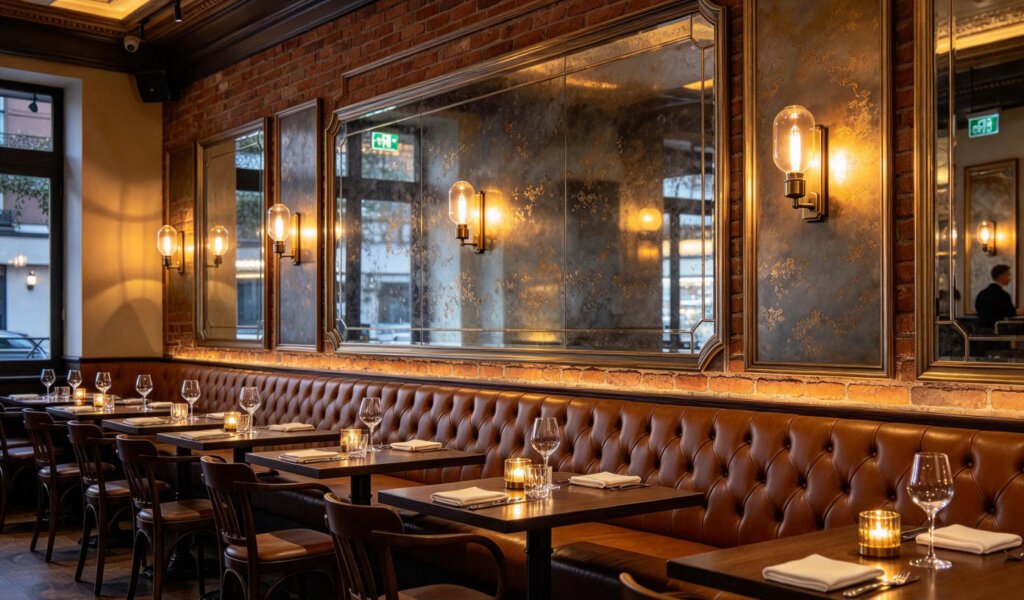
2. Engineering a Moisture-Proof Pub Distressed Glass Backdrop for High-Volume Bars
Why Do Restaurant Antique Wall Mirrors Develop Black Edge Rot Behind Bars?
Fenzi Double-Coated Backing Paint vs. Standard Alkyd Primers
How to Prevent Pub Distressed Glass Backdrop Panels from Cracking Near Draft Taps?
CNC Waterjet Cutout Stress Relief for Liquor Shelving Brackets
Acoustic Vibration Damping Behind Subwoofer-Adjacent Bar Walls
3. Hand-Oxidized vs. Machine-Etched Commercial Vintage Mirror Decor: Factory Cost Breakdown
What Is the Cost Difference Between Hand-Oxidized and Machine-Printed Antique Mirrors?
Comparison Metric
Hand-Oxidized Silver Mirror (Artisanal)
Machine Acid-Etched / Printed Antique Mirror
FOB Factory Cost (6mm Thickness)
$42.00 – $68.00 / sq.m (Cut-to-size & polished)
$26.50 – $39.00 / sq.m (Cut-to-size & polished)
Visual Depth & Iridescence
3D organic layering; authentic gold, cobalt & smoky veins
Uniform 2D repeating pattern every 1.8 to 2.4 meters
Patina Consistency Across Batches
80%–85% match (Each sheet is a unique chemical artwork)
98.5% match (Ideal for 50-store franchise rollouts)
Production Lead Time (300 sq.m)
18–22 Days (Includes manual neutralization & drying)
10–14 Days (Automated conveyor line processing)
Best Hospitality Application
Michelin dining rooms, speakeasy bars, VIP lobby walls
Chain steakhouse ceiling coffers, column wraps, wainscoting
Inside Havenseek Mirror’s Artisanal Silvering Line vs. Automated Roller-Coating
Controlling Patina Consistency Across 300+ Sq.M Multi-Location Restaurant Chains
4. Meeting US & EU Building Codes with Commercial Vintage Mirror Decor
Every commercial hospitality shipment from Havenseek Mirror is engineered to meet US ANSI Z97.1 safety glazing, CPSC 16 CFR 1201 Category II, and European EN 12600 impact resistance (Class 1B1 / 2B2) standards.
Can Commercial Vintage Mirror Decor Pass US and EU Fire and Impact Codes?
Solution A: CAT II 150-Micron Woven Safety Backing Film
Solution B: 3mm+3mm EVA Laminated Distressed Mirror Panels
Solution C: Temperable Chromium-Based Antique Mirror for Kitchen Pass-Throughs
What Is the Best Thickness for Restaurant Antique Wall Mirrors in High-Traffic Dining Zones?
5. Structural Mounting Protocols & Costly Fit-Out Mistakes in Aged Mirror Interior Styling
Concealed Z-Clip Brackets vs. Heavy-Duty J-Channel + Neutral-Cure Mirror Mastic
Can Contractors Cut Antique Mirror Sheets On-Site Without Peeling the Silver Backing?
5 Million-Dollar Installation Mistakes That Ruin Restaurant Antique Wall Mirrors
6. Pre-Shipment QC & Ocean Freight Protection for Bulk Hospitality Orders
How Does Havenseek Mirror Prevent Glass Mildew During Ocean Freight?
The 7-Point Factory Uncrating & Edge-Seal Inspection Checklist
Inspection Step
Tolerance Standard
Verification Tool / Method
1. Tilt-Watch & Shock-Indicator Check
Indicator vial must remain clear (Not red)
Photograph exterior crate shock sticker before unbolting lid.
2. Diagonal Dimensional Accuracy
±1.0mm for CNC cut panels up to 2,400mm
Cross-measure corner-to-corner with calibrated steel tape.
3. Cross-Hatch Paint Adhesion Test
ASTM D3359 Grade 5B (0% flaking)
Apply 3M 600 tape over factory sample coupon grid and pull sharply.
4. CNC Cutout & Bevel Polish Quality
Zero clamshell chips > 0.5mm
Run a cotton swab around all socket cutouts; fibers must not snag.
7. Real-World Case Studies: Before & After Hospitality Transformations
Case Study 1: A 1,850 Sq.Ft Prime Steakhouse in Chicago (Banquette Wall Overhaul)
By sourcing factory-direct from Havenseek Mirror rather than a local architectural glass distributor ($195/sq.m quoted locally vs. $64/sq.m CIF Chicago), the ownership group saved $21,400 and paid off the entire mirror installation inside seven weeks of higher beverage revenue.Case Study 2: A High-Volume Craft Gin Pub in Manchester, UK (Full Backbar Cladding)
8. Frequently Asked Questions About Restaurant Antique Wall Mirrors
1. Why do restaurant antique wall mirrors develop black edge rot behind bars?
2. How does aged mirror interior styling increase small bistro seating value?
3. Can commercial vintage mirror decor pass US and EU fire and impact codes?
4. What is the cost difference between hand-oxidized and machine-printed antique mirrors?
5. How to prevent pub distressed glass backdrop panels from cracking near draft taps?
6. What is the best thickness for restaurant antique wall mirrors in high-traffic dining zones?
7. Can contractors cut antique mirror sheets on-site without peeling the silver backing?
8. How does Havenseek Mirror prevent glass mildew during ocean freight?
9. Partner with Havenseek Mirror for Your Next Hospitality Glazing Project
Send us your CAD elevations, mood board photos, or rough wall dimensions today. Click here to Request Free 100x100mm Antique Mirror Sample Box & Get Your Custom Factory Engineering Quote in 12 Hours. Our senior glazing engineers will review your local building codes, recommend the exact backing specification for your restaurant antique wall mirrors, and lock in guaranteed factory-direct production slots.Authoritative Industry References & Standards